Tags
Quartet for the End of Time: Mark Wilson sings his paint in verse.
 ”Good writers are those who keep the language efficient. That is to say, keep it accurate, keep it clear.” Ezra Pound
The poet bruises so easily
for he knows the secrets
of Deconstruction
Whilst erecting linguistic basilicas
he simultaneously deregulates his muse
with a bottle of shiraz or whiskey
He envisions the body’s
true incorruptibility
whilst his flesh feels nothing but
genuine corruption
(from The Poets Body – Quartet for the End of Time)
And thus spake Mark Wilson, poet after the blood thrust and heart of Ezra Pound: blunt, clear and erotically uncompromising. In an ocean of words polluted with the endless description of giraffes and the smallest moments in life of which we are not made, Mark Wilson stands firm in his passion for music, paint and the blessed word. Here is a man for whom the pump and pour of life’s energy transmuted into art, matters. Art is its own reward in this poets world. Each of the sublime poems that make up Quartet for the End of Time are taken from paint, music, words that have gone before him or the very breath of god. Here is an artist willing to stand for the important, question our thinking and deliver beauty in the face of all our inner ugliness.
Quartet for the End of Time starts with a precise acknowledgement of the work of Avo Part – particularly the Tabula Rasa highlighting first Ludus and then Silentium. In the notes Wilson informs us of the development of the unique ‘tintinnabuli’ style in contemporary classical music Avo Part pioneered this with the piece above. Wilson takes us into the heart of our experience of the music with his accompanying poetry:
Those squares zigzag with a
kind of vorticist energy. Splendid
Architectural vistas opening up before
you. From your first, tentative
words like the initial movement
of pawns. Two cubist violins in counter-
point. This game possesses many
levels, is many-dimensioned.
(From Tabula Rasa after Avo Part – Qartet for the End of Time)
I was lured by the power of the words to bring the music to it. The call is to a deeper part of me, an invitation to the alternative. Mark Wilson asks me to feel: Can you feel it? can you feel the music as you open up to it? I’m taken out of my mind by the music and into the poem when I give my pathetic permission for the two to dance with my psyche.
Yours, then, must be a strategist’s mind-
scape, constantly re-fuelling your movements.
Your indefatigable personae always
five or seven moves ahead of
yourself, your invisible
opponent.
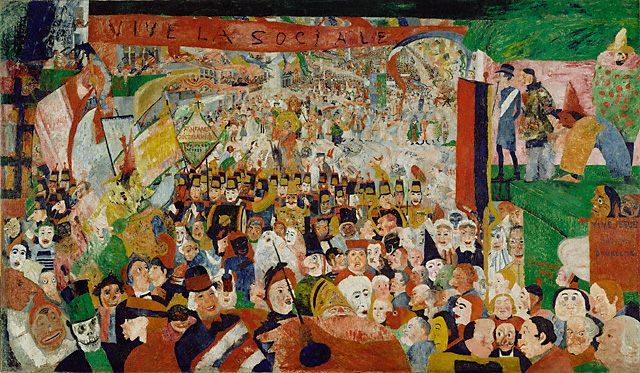
Christ's Triumphal Entry into Brussels. James Ensor
Christ’s Triumphal Entry into London is the tribute poem to the great artist James Ensor. Here mark Wilson has humanity swarm; meddling foolishness of pomp and ceremony in absence of knowing what to do with the power of a moment. The words sound like the look of the art – in Wilson’s gifted hand you can read color. He holds his pen as Ensor holds his brush, sending his psyche to meld with the artists internal machinations. I loved this poem, when I read it in the shadow of this great painting.
Pyrotechnics of stupendous bunting,
superb comet-like streamers. Those
carnivalesque characters striding,
grotesque,
towards the heavy, opening gates.
and then
Fauvist-expressionist this garish-gregarious
crowd, as it ripples rhythmically in mutual
jubilation. Soul-appreciative in this brilliant
one-off, set-piece scenario; cinematically
captured in kaleidoscope diorama:
THIS IS WHAT THE 21ST CENTURY NEEDS
LONG LIVE SOCIAL PROGRESS

Engravced Passions - Albrecht Durer
Many of the poems in Quartet for the end of Time examine the role religion may or may not play in our lives still. Religion for Mark Wilson is a blood/gut response that occurs in the holy church of the body and mind in unison. He questions the role of theology with its ‘Hubble Telescope reliable’ interpretations and calculations. All this, he says, for the odd spectacle of one obscure infant/ mewling in the filthy rags / of a borrowed / humanity/
All of this includes a kind of lament for, not what has been but for what might have been in And the Word Fell.
It Fell justifying its own
innate inerrancy
We are left asking ourselves how we get to a christ? Can we get to a christ? Did we ever have a christ? For this poet the connection between today’s religious iconography and the sweat on the palms of our own reach is all too distant. Wilson tells us it starts with / some crazed dictator / Herod Hitler Pol Pot whoever / working the damned crowd /
There is a link for Wilson between where we are and where we have been warned against being. It is in the emergence after the pain of the every day experience of living – as if from a concentration camp of the soul, that we will come face to face with what we seek. Death of all things beautiful lies in piety and our connection with the spiritual is an elusive thing that will not even answer to our own desire, our splintered agony. History and the church conspire to remove this christ-creature from our grasp. A rich poem – The Circumcision – tells of a madness where ritual and the dividing of the ‘black sheep from the white’ results in a ‘judgement-day scab’ on those who seek a deeper way.

Scenes from the Life of Moses - Sandro Botticelli
In a departure from the christ question, Mark Wilson takes us into his own vulnerability in The garden (A Fantasia in Four Movements) describing the bliss, pleasures and ultimate acceptance of a short-term love affair.
So I must accept your
promulgation of refusal as if
it were a gold-sealed papal-bull
issued to some maligned free-
thinker in a more-or-less
comparably
soulless age.
(from The Garden – Quartet for the End of Time)
Ezra Weston Loomis Pound was an American expatriate poet and critic and a major figure in the early modernist movement in poetry. He became known for his role in developing Imagism, which, in reaction to the Victorian and Georgian poets, favored tight language, unadorned imagery, and a strong correspondence between the verbal and musical qualities of the verse and the mood it expressed. His best-known works include Ripostes (1912), Hugh Selwyn Mauberley (1920), and his unfinished 120-section epic, The Cantos, which consumed his middle and late career, and was published between 1917 and 1969. Mark Wilson’s passion for Pound is evident in every tight word of every poem in this volume. For me the best works are those related to the art. As a fellow ‘passion-ignited-by-art’ soul I understand the rhythms and the hearts pulse that swell underneath each of these poems. As Wilson himself states:
and I swear he comes from
straight out of Chagall painting
for I feel like singing
along with him
as the fierce dogs already surround us
as we enter yet another enervated year
as my winter’s journey runs aground
(As it always must)
for I shuttle back and forth here
like a sad Rook defending an
obsolete kingdom in my
post-post-millennial
endgame
This is where Mark Wilson grabs me, calls to the spirit of the breath under my wings and puffs me Icharus-like toward the sun.
Poetry is always a dangerous business.
When its this good, you have to accept your place as reader in a timeless moment. Throw caution to the wind, and let the spirit of what drives fear dissolve under the skill of the poet-prophet.
Mark Wilson’s Quartet for the End of Time can be purchased here.


Pingback: The defeat of time – Paul Stubbs reviews “Quartet for the End of Time” « Paul Stubbs, poet
Excellent and deep reading of Wilson’s poetry, Lisa, Bravo!
LikeLike
Thanks Seb. I really enjoyed this beautiful book. He’s a fine writer, and he’s fortunate enough to be supported by a great press! 🙂 I had a wonderful time with this.
LikeLike
Many many thanks Lisa for writing this. Your insights are extremely astute and are of great value. I’m glad you were moved and delighted by my poems. I can’t really ask for any more than that!
LikeLike
Thank you Mark. I had ‘moments’ with this. I know you well enough to know you understand completely what I mean by ‘moments’. I particularly enjoyed immersion around the art you were connecting with. You have a unique semblant awareness that took me to a great place.
Who needs drugs baby, when we have this on tap?
Thank you again for all your amazing work.
LikeLike
Thanks again, Lisa. I’m glad you experienced epiphanies whilst reading this collection. Your use of Youtube clips and Googled art images make this page an-depth resource for my book. Even more so than my notes actually. Fascinating that Paul (in his review of the book) felt the ‘music’ poems were my strongest works but you thought the ‘painting/art’ poems resonated more with you. I appreciate this kind of polyphony! Anyway, keep up the writing and this vibrant blog. Now I know how to feedback on this i’m sure I’ll post more.
LikeLike
It’s my pleasure! I read the work a few times (once over a very very pleasant breakfast in my petit bohemian part of the world – it was divine – great coffee, great words, great poached egg on sourdough!) but it really came alive for me when I attached it to the art you suggest in your notes. I wanted to try to convey THAT rather than offer a break down analysis (something Paul can do far better than me).
I wish very very greatly people would take more time with poetry. It is an entirely separate door to the psyche that can’t be matched in any other art form.
And thank you so much for your generous comments.
I’m not on any social media any more. I can’t afford the time with my novel work and frankly, have no desire to provide such rich content for other peoples platforms any longer. I really appreciate your wonderful comments. Thanks again.
LikeLike
Hi Lisa, Thought you might like to know that The Waterboys are touring Australia next January. They play Sydney 23rd of January. I am not sure of any other dates as yet. This will be the first time they have ever toured Australia. I remember you asking me last year whether they were going to play down under,
very best,
Mark
LikeLike
Hey Mark – I did know this, but don’t have my tickets yet. I’ll be going though!
🙂
LikeLike